Each node is a theory. The edges represent influences, theoretical inheritances and critical dialogue. Click on a node to open its card.
Disciplines
Emerging clusters in the graph
Objective. Identify the great families or currents of thought on consciousness as they emerge from the very structure of the catalogue's connections, without imposing an a priori classification by discipline or epoch. It is an analysis complementary to the five scores: instead of measuring, it groups.
Methodology. The Louvain algorithm is applied to the undirected graph of the 222 theories and their 864 connections. Louvain seeks the partition that maximizes modularity, a metric capturing when a grouping is real (the nodes of the same group are more connected to each other than would be expected by chance). At resolution 1.0, 7 clusters emerge with modularity 0.561 (>0.4 is already considered a strong partition).
The clusters have very clear thematic identity and are not algorithmic artefacts. Each is characterized by its disciplinary/temporal/geographical profile, its most central theories (the most connected within the cluster) and its bridge theories (those that connect with the other clusters through high betweenness).
Visualization of the graph coloured by cluster
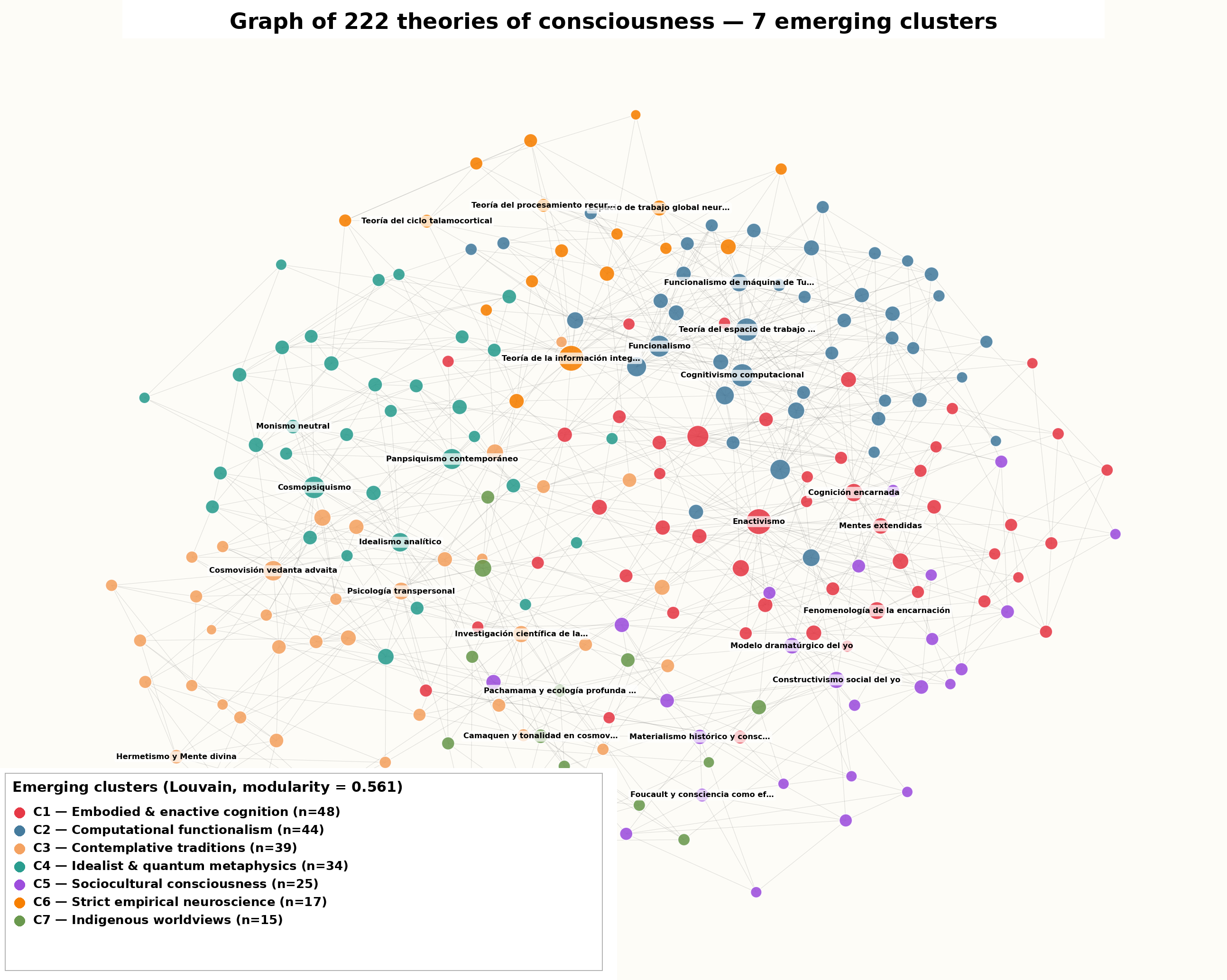
Kamada-Kawai layout · nodes sized by degree · only the 4 most central theories per cluster are labelled
The 7 clusters
C1 — Embodied and enactive cognition
Disciplines: Neuroscience (11) · Philosophy (9) · Cognitive sciences (8) · Biology (7)
Epochs: Second half of the 20th century (19) · 21st century (15) · First half of the 20th century (9)
Regions: Europe (29) · North America (12) · Latin America (3)
Edges to other clusters: 94
The largest and most central cluster of the graph. It brings together the European phenomenological inheritance (Husserl → Merleau-Ponty → Varela) and translates it into a contemporary cognitive key (situated cognition, extended mind, enactivism, predictive processing). It is the hub that articulates continental philosophy, experimental cognitive science and systems biology. That enactivism has the highest betweenness of the graph is no coincidence: this tradition is literally designed to be a bridge between epistemic cultures.
Central theories (highest degree within the cluster):
- Enactivism — Francisco Varela, Evan Thompson, Eleanor Rosch internal degree 23 · external 7
- Phenomenology of embodiment — Maurice Merleau-Ponty internal degree 13 · external 0
- Embodied cognition — George Lakoff, Mark Johnson, Antonio Damasio (precursors) internal degree 12 · external 2
- Extended Mind — Andy Clark, David Chalmers internal degree 10 · external 1
- Predictive processing — Karl Friston, Andy Clark, Jakob Hohwy internal degree 10 · external 11
- Situated cognition — Lucy Suchman, James Greeno internal degree 9 · external 2
Bridge theories (high projection toward other clusters):
- Predictive processing — Karl Friston, Andy Clark, Jakob Hohwy betweenness 0.069 · projects to C2×5, C3×3, C5×1, C4×1, C6×1
- Enactivism — Francisco Varela, Evan Thompson, Eleanor Rosch betweenness 0.118 · projects to C3×3, C2×2, C4×2
- Collective intelligence and social consciousness — Pierre Lévy, Kevin Kelly, Douglas Engelbart betweenness 0.018 · projects to C7×2, C5×2, C2×1
C2 — Computational functionalism and analytic philosophy
Disciplines: Philosophy (19) · Computing / AI (15) · Neuroscience (4) · Cognitive sciences (3)
Epochs: Second half of the 20th century (23) · 21st century (14) · First half of the 20th century (4)
Regions: North America (28) · Europe (10) · Oceania / Aboriginal (4)
Edges to other clusters: 87
The Atlantic-analytic cluster par excellence. It articulates the Anglo-Saxon tradition of philosophy of mind (Putnam, Fodor, Block, Dennett, Chalmers) with computational cognitivism and artificial intelligence. Its adherence to the North America + second half of the 20th century axis reflects the real history of its formation. It separates from C1 by a deep difference: here the mind is computation of representations, there it is embodied coupling with a world.
Central theories (highest degree within the cluster):
- Functionalism — Hilary Putnam, Jerry Fodor internal degree 17 · external 4
- Global workspace theory — Bernard Baars internal degree 16 · external 8
- Computational cognitivism — George Miller, Jerome Bruner, Ulric Neisser, Herbert Simon internal degree 16 · external 8
- Turing-machine functionalism — Hilary Putnam (early), Ned Block internal degree 13 · external 1
- Artificial consciousness and superintelligence — Nick Bostrom, Stuart Russell, Ilya Sutskever internal degree 13 · external 4
- Philosophical zombie argument — David Chalmers internal degree 10 · external 0
Bridge theories (high projection toward other clusters):
- Computational cognitivism — George Miller, Jerome Bruner, Ulric Neisser, Herbert Simon betweenness 0.066 · projects to C1×5, C4×3
- Biological naturalism — John Searle betweenness 0.041 · projects to C6×4, C5×2, C1×1
- Centre of narrative gravity — Daniel Dennett betweenness 0.028 · projects to C5×6, C3×1, C7×1
C3 — Contemplative traditions and the science of meditation
Disciplines: Spirituality (23) · Neuroscience (6) · Psychology (6) · Philosophy (2)
Epochs: Antiquity (≤500 CE) (11) · 21st century (9) · Medieval (500-1500) (7)
Regions: Europe (12) · North America (9) · India / South Asia (8)
Edges to other clusters: 70
A cluster with dual temporal genesis: it merges millennial traditions (Vedanta, Christian mysticism, Hermeticism, Buddhism) with their contemporary scientific reinterpretation (clinical meditation, psychedelics, transpersonal psychology). The bimodal distribution (Antiquity + 21st century, almost nothing in between) reflects that there is no institutional continuity but a revival. Ken Wilber acts as the great synthesizer. The entropic brain and the science of psychedelics are the hinges toward experimental neuroscience.
Central theories (highest degree within the cluster):
- Advaita Vedānta — Adi Shankara (systematiser) internal degree 11 · external 7
- Scientific research on meditation — Antoine Lutz, Richard Davidson, Wolf Singer internal degree 10 · external 2
- Transpersonal psychology — Stanislav Grof, Charles Tart, Ken Wilber internal degree 9 · external 4
- Hermeticism and the Divine Mind — Hermes Trismegisto (attributed), Ficino internal degree 8 · external 0
- Christian mysticism — Meister Eckhart, Teresa de Ávila, Juan de la Cruz internal degree 8 · external 2
- Wilber's integral model — Ken Wilber internal degree 8 · external 4
Bridge theories (high projection toward other clusters):
- Buddhist anātman — Buddha Śākyamuni, Nāgārjuna, Vasubandhu betweenness 0.025 · projects to C2×3, C1×2, C4×2
- Advaita Vedānta — Adi Shankara (systematiser) betweenness 0.037 · projects to C4×6, C1×1
- Entropic brain — Robin Carhart-Harris betweenness 0.034 · projects to C6×3, C1×2
C4 — Idealist, quantum and panpsychic metaphysics
Disciplines: Philosophy (13) · Physics (11) · Psychology (3) · Spirituality (2)
Epochs: Second half of the 20th century (10) · 21st century (8) · First half of the 20th century (8)
Regions: Europe (16) · North America (14) · India / South Asia (2)
Edges to other clusters: 78
The cluster where consciousness is cosmic or fundamental. It groups the proposals that reject physicalist emergentism: panpsychism (Strawson, Goff, Seager), cosmopsychism, analytic idealism (Kastrup), neutral monism (Russell, Mach), and, strikingly, a strong representation of interpretations of quantum mechanics that make room for conscious observation (Wigner, Bohm, QBism, holographic). The strong connection with C3 is no accident: they share the rejection of reductive materialism.
Central theories (highest degree within the cluster):
- Cosmopsychism — Philip Goff, Yujin Nagasawa, Itay Shani internal degree 16 · external 6
- Contemporary panpsychism — Galen Strawson, Philip Goff, William Seager internal degree 12 · external 7
- Analytic idealism — Bernardo Kastrup internal degree 10 · external 6
- Neutral monism — Bertrand Russell, William James, Ernst Mach internal degree 8 · external 0
- Copenhagen interpretation (Wigner) — Eugene Wigner, John von Neumann internal degree 8 · external 0
- Holographic theory of the universe — David Bohm, Karl Pribram, Leonard Susskind internal degree 8 · external 0
Bridge theories (high projection toward other clusters):
- Pragmatism and stream of consciousness — William James betweenness 0.037 · projects to C2×2, C3×2, C1×1
- Contemporary panpsychism — Galen Strawson, Philip Goff, William Seager betweenness 0.051 · projects to C1×4, C2×1, C6×1, C3×1
- Jungian analytical psychology — Carl Gustav Jung betweenness 0.026 · projects to C3×5, C5×2
C5 — Consciousness as sociocultural construction
Disciplines: Sociology (11) · Psychology (5) · Philosophy (4) · Neuroscience (3)
Epochs: Second half of the 20th century (13) · First half of the 20th century (6) · 19th century (3)
Regions: Europe (15) · North America (9) · East Asia (1)
Edges to other clusters: 51
The theories that say consciousness is a social effect, not an individual property. Marx, Durkheim, Mead, Goffman, Foucault, Adorno, cultural studies — the sociological turn. The surprising presence of Jaynes's bicameral hypothesis makes sense here: it also treats consciousness as a historical product, although from a psycho-cultural angle. Freudian psychoanalysis is the most connected hinge toward other territories.
Central theories (highest degree within the cluster):
- Historical materialism and consciousness — Karl Marx, Friedrich Engels internal degree 9 · external 0
- Social constructivism of the self — Kenneth Gergen, John Shotter internal degree 9 · external 3
- Dramaturgical model of the self — Erving Goffman internal degree 8 · external 3
- Foucault and consciousness as effect of power — Michel Foucault internal degree 7 · external 0
- Bicameral mind hypothesis — Julian Jaynes internal degree 6 · external 0
- Frankfurt School and critique of instrumental reason — Horkheimer, Adorno, Marcuse internal degree 6 · external 0
Bridge theories (high projection toward other clusters):
- Absolute idealism — Georg Wilhelm Friedrich Hegel betweenness 0.031 · projects to C4×2, C3×2, C1×1
- Freudian psychoanalysis — Sigmund Freud betweenness 0.021 · projects to C4×2, C2×1, C1×1, C7×1
- Durkheim's collective consciousness — Émile Durkheim betweenness 0.017 · projects to C2×1, C1×1, C7×1
C6 — Strict empirical neuroscience
Disciplines: Neuroscience (15) · Biology (1) · Philosophy (1)
Epochs: 21st century (9) · Second half of the 20th century (8)
Regions: North America (10) · Europe (6) · Latin America (1)
Edges to other clusters: 49
The most disciplinarily pure cluster of the catalogue (15 out of 17 are neuroscience). They are the concrete empirical theories about the neural how of consciousness: gamma oscillations, thalamocortical binding, recurrent processing, NCC, IIT, neural GWT. IIT acts as an ambassador outward: it connects with philosophy of mind (C2), panpsychism (C4 — through Tononi's strong thesis) and 4E (C1). It is a small cluster but theoretically very dense.
Central theories (highest degree within the cluster):
- Global neuronal workspace (GNW) — Stanislas Dehaene, Jean-Pierre Changeux, Lionel Naccache internal degree 8 · external 2
- Integrated information theory — Giulio Tononi, Christof Koch internal degree 8 · external 22
- Recurrent processing theory — Victor Lamme internal degree 7 · external 0
- Thalamocortical loop theory — Rodolfo Llinás internal degree 7 · external 0
- Binding by synchrony — Wolf Singer, Andreas Engel internal degree 7 · external 0
- Neural correlates of consciousness — Francis Crick, Christof Koch internal degree 6 · external 3
Bridge theories (high projection toward other clusters):
- Integrated information theory — Giulio Tononi, Christof Koch betweenness 0.105 · projects to C2×9, C4×7, C1×4, C3×2
- Complex systems and emergence — Stuart Kauffman, Murray Gell-Mann betweenness 0.017 · projects to C2×1, C1×1, C7×1, C3×1, C4×1
- Neural correlates of consciousness — Francis Crick, Christof Koch betweenness 0.016 · projects to C2×2, C3×1
C7 — Indigenous and animist worldviews
Disciplines: Indigenous tradition (8) · Psychology (3) · Biology (1) · Theology (1)
Epochs: Second half of the 20th century (4) · Antiquity (≤500 CE) (4) · Medieval (500-1500) (3)
Regions: Europe (4) · Latin America (4) · North America (2)
Edges to other clusters: 33
The most isolated cluster of the corpus, with only 33 external edges — fewer than any other. This is consistent with its character: indigenous worldviews are documented mainly in their cultural context, with few bidirectional influences toward Western academic thought. Gaia plays a singular role: it is a Western theory that, for historical reasons (ecocentrism, planetary self-regulation), connects naturally with Pachamama and animist cosmologies. Ubuntu also introduces a dimension outside the Indo-pre-Columbian axis.
Central theories (highest degree within the cluster):
- Camaquen and tonality in Andean cosmovision — Quechua and Aymara tradition internal degree 8 · external 0
- Pachamama and indigenous deep ecology — Contemporary Andean cosmovision, Sumak Kawsay internal degree 6 · external 0
- Mexica teyolía, tonalli and ihíyotl — Sahagún (chronicler), Nahuatl tradition internal degree 5 · external 0
- Circumpolar shamanic traditions — Tungus, Inuit, Sami and Tuvan traditions internal degree 5 · external 0
- Maori and whakapapa — Mason Durie, Maori tradition internal degree 5 · external 0
- Ritual trance and possession — Gilbert Rouget, comparative anthropology internal degree 5 · external 0
Bridge theories (high projection toward other clusters):
- Gaia hypothesis — James Lovelock, Lynn Margulis betweenness 0.035 · projects to C4×3, C1×3, C3×2, C6×1
- Dissociation and multiple consciousness — Pierre Janet, Frank Putnam betweenness 0.022 · projects to C5×3, C4×1, C2×1
- Ubuntu and the person-in-community — John Mbiti, Desmond Tutu betweenness 0.019 · projects to C5×3, C1×1, C4×1
Map of connections between clusters
The most connected pairs of clusters (most shared edges):
- C1 ↔ C2: 28 edges — Embodied and enactive cognition ↔ Computational functionalism and analytic philosophy
- C3 ↔ C4: 28 edges — Contemplative traditions and the science of meditation ↔ Idealist, quantum and panpsychic metaphysics
- C2 ↔ C6: 23 edges — Computational functionalism and analytic philosophy ↔ Strict empirical neuroscience
- C1 ↔ C3: 20 edges — Embodied and enactive cognition ↔ Contemplative traditions and the science of meditation
- C1 ↔ C5: 18 edges — Embodied and enactive cognition ↔ Consciousness as sociocultural construction
- C2 ↔ C5: 15 edges — Computational functionalism and analytic philosophy ↔ Consciousness as sociocultural construction
- C1 ↔ C4: 13 edges — Embodied and enactive cognition ↔ Idealist, quantum and panpsychic metaphysics
- C2 ↔ C4: 13 edges — Computational functionalism and analytic philosophy ↔ Idealist, quantum and panpsychic metaphysics
The C1 ↔ C2 axis (4E vs Functionalism) is the great opposition/dialogue axis of the contemporary cognitive debate. The C3 ↔ C4 axis (Contemplative vs Idealist metaphysics) shows that the alternative proposals to physicalism converge with each other. C7 (indigenous) is the most peripheral cluster of the corpus, with fewer external edges than any other.
Main findings
- 4E cognition (C1) is the true structural centre of the graph, not empirical neuroscience. It has the highest betweenness and connects with all seven clusters.
- Three theories are total ambassadors (central in their cluster + bridges + top of the Synthetic Score): Enactivism (C1), Integrated information theory (C6) and Computational cognitivism (C2). If we wanted to reduce the catalogue to three references, these would allow us to open any conversation.
- Contemplative traditions (C3) and idealist metaphysics (C4) legitimize each other: they share the rejection of physicalism and that is why they appear as the second great axis of the graph.
- The sociocultural cluster (C5) is invisible to the Synthetic Score: none of its theories enters the SS top 20. Its relevance is dense intra-cluster but does not project toward the rest of the corpus.
- Indigenous worldviews (C7) remain a relatively closed territory in the academic bibliography of the corpus. A descriptive, not normative, observation.
The 5 core theories of the corpus
By crossing the Synthetic Score with the analysis of emerging clusters, a "minimum library" of five theories that cover practically the entire catalogue emerges. Each is optimal from two independent criteria that converge on the same name: they are simultaneously locally representative (central in their cluster) and globally projective (relevant across multiple scores).
The 5 core theories
| # | Theory | Cluster it opens | Why central in cluster | Why relevant in the score |
|---|---|---|---|---|
| 1 | Enactivism Varela, Thompson, Rosch |
C1 · 4E cognition | #1 central in the cluster + highest betweenness in the graph (0.118) | #1 SS = 0,989, percentiles ≥ 0.83 across all 5 dimensions |
| 2 | Integrated information theory Tononi, Koch |
C6 · Empirical neuroscience | #2 central + betweenness 0,105, the only outward ambassador of neuroscience | #5 SS = 0,965, top 1 in IS, top 2 in CS and SDU |
| 3 | Computational cognitivism Miller, Bruner, Simon, Neisser |
C2 · Computational functionalism | #3 central + bridge to C1 and C4 | #4 SS = 0,968, top in IS and DCS, solid in everything |
| 4 | Advaita Vedānta Adi Shankara |
C3 · Contemplative traditions | #1 central by a wide margin + only node that opens the cluster with critical mass | #2 SS = 0,974, top 1 in HPS and SDU |
| 5 | Social constructivism of the self Mead, Cooley, Gergen |
C5 · Sociocultural consciousness | Tied for most central + only node of C5 with external projection | #43 SS = 0,831 (best of its cluster by far; the rest fall to ranks 91-218) |
The first four are "natural" ambassadors: they dominate their cluster AND appear in the Synthetic Score top 5. Social constructivism of the self is the exception — its cluster (C5) is structurally endogenous, so none of its members enters the SS top 20. But among the nodes of C5, Constructivism is the least endogamic: the only one with high percentiles in DCS (0.98), UDS (0.72) and HPS (0.69).
Graph coverage
The 5 theories, through short paths in the connection graph, reach:
| Distance | Coverage |
|---|---|
| 1 step (direct neighbours) | 108 / 222 = 48,6% |
| 2 steps (neighbours and neighbours of neighbours) | 214 / 222 = 96,4% |
The second jump doubles the coverage: it reflects that the catalogue has a small-world topology in which each central theory links to 20-30 direct neighbours, but through them one accesses almost the entirety of the corpus in one additional jump.
Coverage by cluster
| Cluster | Size | 1 step | 2 steps |
|---|---|---|---|
| C1 4E cognition | 48 | 60,4% | 100% |
| C2 Computational functionalism | 44 | 56,8% | 100% |
| C3 Contemplative traditions | 39 | 43,6% | 97,4% |
| C4 Idealist/quantum metaphysics | 34 | 50,0% | 100% |
| C5 Sociocultural consciousness | 25 | 40,0% | 96,0% |
| C6 Empirical neuroscience | 17 | 52,9% | 100% |
| C7 Indigenous worldviews | 15 | 6,7% | 60,0% |
In 2 steps four clusters are completely covered (C1, C2, C4 and C6 = 143 theories = 64% of the catalogue). C3 and C5 are covered at 96-97% thanks to Vedanta and Constructivism. C7 (indigenous worldviews) reaches 60% as a residual bonus: the Gaia hypothesis and other biological-ecological theories act as a hinge from the other ambassadors. Only 8 theories out of 222 remain completely out of reach — and most are indigenous worldviews culturally disjoint from the Western-academic axis.
Why this is the best combination of theories
- Minimal: 5 theories cover 96.4% of the catalogue in 2 steps.
- Disciplinarily balanced: one per cluster in the five largest clusters of the academic corpus (C1, C2, C3, C4 and C5).
- Temporally balanced: one from antiquity (Vedanta, 8th c.), one from the 19th-20th c. (Constructivism), three from the 20th-21st c. (Enactivism, IIT, Cognitivism).
- Geographically balanced: 2 from North America (IIT, Cognitivism), 1 transatlantic (Enactivism, USA-Chile), 1 from India (Vedanta), 1 European-North American (Constructivism).
- Robust across multiple criteria: they emerge from the crossing of three independent analyses (clusters by graph structure, Synthetic Score by multi-dimensional profile, optimal coverage by 2-step reach). The convergence of the three gives statistical confidence.
CONCLUSION
These 5 theories constitute a very balanced "minimum library" of thought on consciousness: three theories from the contemporary cognitive-neuroscientific debate, a millennial tradition that opens the contemplative universe, and a social-sciences theory that opens the constructionist universe. These five names allow practically any debate in the catalogue to be opened.
Objective of the proposal
This section develops two alternatives of a unified theory of consciousness that take as their starting point the five core theories identified in the Core theories section: Advaita Vedānta, Integrated Information Theory (IIT), Enactivism, Computational Cognitivism and Social Constructivism of the Self.
The purpose is not to choose a theory as the true one, nor to catalogue all existing integrative proposals. It is to attempt a real integration of the five visions, seeing them as complementary — partial approaches from different perspectives — and not as rivals that cancel each other out. For the integration to be effective and not merely juxtaposed, a hierarchical model is adopted: one of the five theories occupies the foundational ontological position, and the others are articulated upon it as descriptions of successive levels of the phenomenon.
Why two alternatives
The hierarchical commitment requires deciding which level is assumed as the foundation. Here the five core theories split into two opposing ontological positions:
- Idealist position: consciousness is ontologically primary; the material appears within it. This is the classical position of Advaita Vedānta.
- Materialist-emergentist position: matter is ontologically primary; consciousness emerges from certain physical configurations. This is the typical position of Integrated Information Theory in its naturalist reading.
Both positions allow building a hierarchical architecture coherent with the other three theories, but they lead to opposing models: in one the flow goes from universal consciousness to its individual modulation; in the other, from matter with integrated information to the phenomenological recognition of the ground. No empirical criterion currently allows deciding between the two positions, but it is possible to show that each one coherently articulates the five theories without trivially reducing them to one another.
Structure of each proposal
Each of the two alternatives is developed with the same structure to facilitate comparison:
- Central thesis: the ontological position assumed.
- Foundational level: detailed description of the theory that occupies the base.
- Intermediate levels: how the other three major theories (IIT/Vedanta and the two remaining — enactivism and cognitivism) are articulated upon the foundation.
- Constructivism: appears in both as a final addition, socially modulating the self.
- Graphic scheme: the hierarchical order of the levels.
- Synthetic formulation: a sentence that captures the whole model.
The two proposals are developed in the two following subtabs. They are presented as alternatives; the reader can choose which one they find more convincing according to their own background intuitions.
Alternative A — Idealist model:
Advaita Vedānta as foundation
Central thesis
There exists a universal consciousness, without parts and without borders, which is the ultimate ontological substrate of all that is real. This consciousness is not an emergent property of the human brain: it is what comes first. What we call "individual consciousness" in a human being is not something distinct from universal consciousness but a local modulation of it, restricted by the physical structure of a specific organism.
The other four core theories describe, in contemporary scientific terms, how universal consciousness is actualised and expressed in a singular human being. IIT describes the physical structure of the modulation, enactivism the mode of relation with the world, cognitivism the form of processing, and constructivism how the social shapes it.
Foundational level — Advaita Vedānta: consciousness as substrate
Before any body, any brain or any material world, there is a single field of manifestation with no subject or object, no time or space: what Advaita calls Brahman and recognizes as identical to Atman (the deepest self). That field is not a substance, not an entity, not a personal god: it is the pure consciousness-ground, the condition of possibility of anything that can be experienced or thought.
Material reality is not an independent reality that then "produces" consciousness: it is a structured modulation of that single consciousness, a series of patterns that appear within it. What common sense calls "objects" or "bodies" are stable, recognizable configurations of the field. The separation between subject and object is real for ordinary experience but ontologically derived — it emerges within the field, it does not constitute it.
Individuation level — from the single field to the human subject
How, from a single field of consciousness, do finite individual subjects arise? Advaita answers with the concept of maya: the appearance, the play of concealment by which the One lives itself as many. The singular human being is a structured "window" of universal consciousness: a region of the field whose physical-biological organisation produces a localised, finite and temporal point of view. The other three core theories describe that structuring.
Structural aspect — IIT: integrated information architecture
What makes a human brain a rich "window" of universal consciousness and a stone not, is not that the brain produces consciousness (consciousness was already there), but that it offers the physical architecture best suited to condense it into a coherent point of view. That architecture is what IIT formalizes: a system whose integrated information (Φ) is irreducible — that is, a system whose current state cannot be decomposed into states of independent parts without losing structure.
Seen from the Vedānta base, Φ does not measure how much consciousness there is; it measures how articulated and rich the local modulation of the single field is in that system. A human brain has high Φ; that is why it is capable of manifesting universal consciousness with high resolution, differentiated content, temporal integration. A stone has nearly zero Φ; the single field passes through it without condensing into a point of view. IIT thus provides the physical principle of individuation.
Relational aspect — enactivism: projection toward the world
Once a structured window exists, that window does not contemplate the world from the outside: it enacts it. Individual consciousness does not passively receive representations from the exterior; it is active, mobile, embodied. It couples through the senses and action, drawing a meaningful world in its own way of being.
Seen from the Vedānta base, enactivism describes how the individuated subject projects the universal field toward an outside that exists as such only because the subject has individuated itself. The "world" of enactivism is not the whole of Brahman (which has no outside): it is the region of the field that appears as world from the subject's point of view. Embodiment, sensorimotor coupling and action are the modes in which the local modulation interacts with the rest of the field.
Operational aspect — cognitivism: information processing
On top of the structural architecture and the enactive coupling, a layer of concrete information processing also operates: perceptions, memories, inferences, decisions, plans. Cognitivism describes this layer as manipulation of representations under rules. It is the operational machinery the subject uses to navigate the world it enacts.
Seen from the Vedānta base, "representations" are patterns of modulation within the field: configurations of the field that the subject can manipulate and combine, not immaterial entities nor "objective information". Cognitivism is right in its functional description, without needing classical representational metaphysics if the background monism is accepted.
Additional layer — constructivism
In social beings such as the human, on top of the previous three aspects there is an additional layer of social modelling of the self. The autobiographical "I", the subject who says "I" and recognizes itself in a story, is largely constructed in interaction with others: through the internalization of gazes, narratives, roles and cultural categories.
Seen from the Vedānta base, this layer is superficial but not irrelevant. Superficial because it does not touch the ground (Atman/Brahman): the socially constructed self is a pattern in consciousness, not consciousness itself. Not irrelevant because it conditions the way in which human consciousness lives itself, suffers or is liberated. The great meditative tradition coincides with this reading: the constructed self is real as a construction, and dissolving it is part of the path toward the recognition of the ground.
Graphic scheme
            BRAHMAN (universal consciousness, without parts)
                          │
                  [ maya / individuation ]
                          │
                          ▼
        ┌─────────────────────────────────┐
        │     individuated consciousness   │
        │       in the human being         │
        └────┬───────────┬───────────┬─────┘
             │           │           │
             ▼           ▼           ▼
        IIT          Enactivism   Cognitivism
    (architecture   (projection   (information
   of high Φ that   toward the     processing
    individuates    world, in      in the
    the field)      embodied       individuated
                    coupling)      modulation)
                          │
                          ▼
                  Constructivism
              (social modulation of
               the narrative self,
               superficial added layer)
Synthetic formulation in one sentence
Consciousness is a single field of manifestation (Vedanta) that individuates itself in human bodies through physical architectures of high integrated information (IIT), which actively project a world through sensorimotor coupling (Enactivism) and operate internally through processing of representations (Cognitivism), additionally modelled socially in the narrative "I" (Constructivism).
Closest current development
The contemporary work closest to this architecture is that of the Dutch philosopher Bernardo Kastrup and his programme of Analytic Idealism. Kastrup explicitly defends that universal consciousness is the only ontologically fundamental thing ("universal phenomenal consciousness is all there ultimately is, everything else in nature being reducible to patterns of excitation of this consciousness") and recognizes his affinity with Advaita Vedānta, Yogācāra and Kashmir Shaivism.
His distinctive contribution in recent years has been to propose a concrete mechanism for individuation: universal consciousness "fragments" into finite subjects through dissociative processes, and the exclusion principle of Integrated Information Theory offers the mathematical formalization of how this dissociation produces regions of high Φ irreducible to each other. This Vedanta + IIT articulation is precisely the one that occupies the base of the present alternative, although Kastrup does not systematically integrate the subsequent layers (enactivism, cognitivism, constructivism).
Selected references:
- Kastrup, B. (2019). The Idea of the World: A Multi-disciplinary Argument for the Mental Nature of Reality. Iff Books.
- Kastrup, B. (2021). Analytic Idealism: A consciousness-only ontology. Doctoral dissertation, Radboud University. Available on PhilArchive.
- Kastrup, B. (2024). "Analytic Idealism, UAPs, the Daimon, and a model of dissociation". Programmatic essay on the use of IIT as a model of dissociation.
Alternative B — Materialist-emergentist model:
Integrated Information Theory as foundation
Central thesis
What comes first, ontologically, is matter and its physical-informational configurations. Consciousness is not an initial datum: it emerges when matter is organized in a certain way. What contemplative traditions describe as "universal consciousness" is not a primary metaphysical entity but the limit experiential state reached by a conscious system when it develops, becomes more complex and trains its capacity for self-observation.
The other four core theories describe, in increasing order of complexity, how conscious experience is built on the physical-informational substrate: first as an embodied living system, then as a cognitive system, then as a socially constituted subject, and finally as phenomenological access to the ground of appearance.
Foundational level — IIT: matter with integrated information
Before any consciousness there is matter organized according to certain physical laws. The key question is: what kind of material configuration generates experience? IIT offers a mathematically precise answer: one whose integrated information (Φ) is irreducible. A system with high Φ is a system whose current state cannot be decomposed into states of independent parts without losing information. That structural irreducibility is the condition for there to be a point of view.
Consciousness is then an emergent property of a certain type of physical-informational organization. It does not float over matter, nor does it precede matter: it arises from matter when matter reaches the appropriate organization. The foundational postulate is naturalist: everything we call consciousness, at any level, is the result of how physical processes are ordered.
Biological actualization level — enactivism: life and world
Matter with high Φ, in nature, occurs paradigmatically in living organisms. Having an abstract architecture is not enough; a living body coupled to an environment is needed for experience to have content. Enactivism describes this level: cognition is not passive representation but enaction — the organism brings forth a meaningful world through its sensorimotor coupling with the environment.
Seen from the IIT base, enactivism adds the evolutionary and biological factor: the consciousness that IIT allows structurally is actualized concretely in living systems whose brain architecture has been shaped by the selective pressure of coupling with a world. Embodiment is not a decorative addition: it is the historical-evolutionary mode in which matter with high Φ acquires specific experiential content.
Functional level — cognitivism: information processing
Upon the enactively coupled living system, concrete cognitive functions emerge: perception, attention, memory, inference, reasoning, decision, planning. These functions are well described in the language of information processing: representations, computations, rules. Cognitivism is the functional description of what a brain does.
Seen from the IIT base, cognitivism does not compete with it: it operates at a different scale. IIT describes the structural substrate that makes consciousness possible; cognitivism describes the functional operations that occur upon that substrate. Both are compatible if one accepts that functional cognition occurs in systems that satisfy the high-Φ condition.
Social level — constructivism: the construction of the self
In social beings such as the human, upon the cognitive machinery a narrative "I" emerges that is constituted in intersubjective interaction. We learn to say "I" by looking at ourselves in others, internalizing their gazes, narrating our history with words and categories that come from our culture. The autobiographical subject is not an intrinsic property of the brain: it is an emergent pattern that requires language, culture and society.
Seen from the IIT base, constructivism adds a level that the lower layers do not contain: the historical-social dimension of the subject. Human consciousness is not only an embodied, cognitively active informational architecture; it is also a subject whose identity is formed in the network of intersubjective relations.
Phenomenological summit — Vedānta: the recognition of the ground
At the top of the model, in highly developed conscious systems and especially under intensive contemplative training, consciousness can come to recognize itself as a single field without parts. What contemplative traditions — Advaita Vedānta, Buddhism, Christian mysticism — describe as Brahman, emptiness or mystical unity, is the limit experiential state accessible to a human brain when it suspends its egoic filters, its representational categories and the narrative construction of the self.
Seen from the IIT base, this level does not postulate an ontologically new entity: it describes an advanced phenomenology, an achievement of the brain architecture when most of its ordinary processing is withdrawn and only the pure phenomenal substrate remains. Advaita then describes something real (advanced meditators report these states with remarkable cross-cultural consistency), but that "something real" is an experience of a physical system, not a metaphysics.
Graphic scheme
         Phenomenological summit:
         VEDĀNTA — recognition of the ground
         (experiential achievement of the conscious system)
                          ▲
                          │
                  Constructivism
                  (social construction
                   of the narrative "I")
                          ▲
                          │
                   Cognitivism
                   (information
                    processing, cognitive
                    functions)
                          ▲
                          │
                   Enactivism
                   (life, embodiment,
                    coupling with the world)
                          ▲
                          │
                ┌────────────────┐
                │      IIT        │
                │ Matter with     │
                │ integrated      │
                │ information (Φ) │
                │ — ontological   │
                │   substrate     │
                └────────────────┘
Synthetic formulation in one sentence
Consciousness is an emergent property of physical configurations with irreducible integrated information (IIT), which is actualized concretely in living bodies coupled to a world (Enactivism), operates through processing of representations (Cognitivism), is constituted intersubjectively as a narrative self (Constructivism) and, in sufficiently complex and trained systems, can recognize itself as a single field of experience (Vedanta).
Closest current development
The contemporary work closest to this architecture is the Integrated World Modeling Theory (IWMT) of the neuroscientist Adam Safron, published in Frontiers in 2020 and expanded in 2022. IWMT is an explicit synthesis of three of the great mainstream theories of consciousness: Integrated Information Theory (IIT) as description of the structural condition, Global Neuronal Workspace as description of the functional dynamics, and Karl Friston's Free Energy Principle and active inference as the unifying computational framework.
What is most relevant for the present alternative: Safron explicitly places embodiment and somatic agency at the heart of the model ("somatic experiences and agentic selfhood at the core of consciousness"), thus articulating the transition from the IIT substrate toward the enactive and cognitive levels. IWMT does not explicitly include Vedanta as the phenomenological summit, but its author claims that the synthesis "reveals compatibility between leading theories of consciousness, so enabling inferential synergy" — an open invitation to extensions such as ours.
Selected references:
- Safron, A. (2020). "An Integrated World Modeling Theory (IWMT) of Consciousness: Combining Integrated Information and Global Neuronal Workspace Theories With the Free Energy Principle and Active Inference Framework". Frontiers in Artificial Intelligence, 3:30.
- Safron, A. (2022). "Integrated World Modeling Theory expanded: Implications for the future of consciousness". Frontiers in Computational Neuroscience, 16.
- Safron, A. (2021). "Integrated World Modeling Theory (IWMT) Implemented: Towards Reverse Engineering Consciousness with the Free Energy Principle and Active Inference". In Active Inference (Springer).
About this encyclopedia
The Map of Consciousness is an interactive encyclopedia created by Ricardo Forcano with Claude Cowork. It gathers a broad inventory of the theories that humanity has elaborated to explain, describe or inhabit what we call consciousness. Consciousness is probably the most transversal object of study that exists, and one of the great questions of humanity throughout history.
The Map of Consciousness aims to be faithful to that transversality. The catalogue includes philosophical theories, neuroscientific models, physical interpretations, psychological schools, Eastern and Western contemplative traditions, indigenous worldviews, anthropological approaches and properly contemporary proposals. The criterion for inclusion is that the theory has had a minimum of recognition in its field, not that it is true or accepted by the mainstream.
How to use
Use the side filters to narrow down by discipline, epoch or region of the world. The search covers names, authors and the text of the cards. The Connection Map tab lets you see the theories as an interactive graph: two theories are linked when there is between them a relationship of influence, inheritance or critique. The five Score tabs show quantitative rankings of the catalogue from different angles (see next section). The Emerging clusters tab groups the whole catalogue into seven thematic families that emerge from the connection graph itself, identifying the central and bridge theories of each.
Structure of the cards
Each card contains: reference authors, temporal and geographical frame, an explanation of the theory and its proposal about consciousness, the strengths usually recognized in it, the main criticisms received, and a navigable list of related theories.
The five scores
The catalogue includes five quantitative scores, each associated with its own tab. All are computed on the same graph of theories and relations, but they measure different dimensions of a theory's relevance within the corpus. In summary:
- Integration Score (IS). How central and connected a theory is in the global network of influences. It combines four classical centralities of network analysis: degree, betweenness, eigenvector and closeness.
- Coverage Score (CS). What fraction of the catalogue can be reached from a theory in two jumps, penalizing path redundancy. It identifies good entry points to the corpus.
- Disciplinary Crossover Score (DCS). How interdisciplinary a theory is, measured by the proportion of connections it has outside its own discipline and by the diversity of disciplines with which it dialogues.
- Historical Persistence Score (HPS). How relevant a theory has been across seven great epochs of thought on consciousness, from Antiquity to the 21st century. It rewards accumulated longevity.
- Universal Diffusion Score (UDS). How globally distributed a theory's presence is across nine cultural regions of the world. It distinguishes genuinely itinerant theories from those that are very central but localized.
- Synthetic Score (SS). Aggregation of the five previous scores. After converting each score to percentiles, the mean of the three highest percentiles (top-3 mean) is taken for each theory. It rewards relevance from multiple simultaneous reasons, tolerating that a theory may have some weak dimension.
Each score tab shows the detailed objective and methodology, the top 10 with the categories and card of each theory, and a two- or three-paragraph reading of the result. The five scores are descriptive of the graph, not normative: a high score indicates centrality in a technical sense, not greater truth or philosophical importance.
Emerging clusters
The analysis of emerging clusters is complementary to that of the scores: instead of measuring each theory with five indicators, it groups the whole catalogue into families or currents that emerge from the very structure of the connections. The Louvain algorithm is applied to the graph of the 222 theories without imposing any a priori classification by discipline, epoch or region. The quality of the partition is evaluated with the modularity metric, which captures when a grouping is real because the nodes of the same group are more connected to each other than would be expected by chance. For each resulting cluster, its central theories (the most internally connected) and its bridge theories (those connecting with the other clusters through high betweenness) are identified, allowing the corpus to be read from a logic complementary to that of the scores.
Core theories
The core theories of the corpus are identified by crossing three independent analyses: the Synthetic Score (multidimensional profile), the emerging clusters (internal representativeness and projection toward other groups) and the optimal graph coverage (which subset of theories allows reaching most of the catalogue in two jumps through the connections). The convergence of the three criteria points to a small set of theories that are simultaneously central in their cluster and projective toward the rest of the corpus, offering a "minimum library" capable of opening the whole catalogue from a small number of entry points.
Unification proposal
Starting from the core theories, an exercise of theoretical integration is attempted: instead of treating them as rivals, models are explored in which each is articulated as a description of a different level of the same phenomenon. For the integration to be effective and not merely juxtaposed, a hierarchical structure is adopted: one of the theories occupies the foundational ontological position and the others are articulated upon it as descriptions of successive levels.
The hierarchical commitment forces a decision about which level is assumed as the foundation. This admits two opposing ontological positions — one idealist (consciousness is primary) and one materialist-emergentist (matter is primary) — which lead to two coherent but distinct architectures. That is why two alternatives are developed, presented as equally articulable; the reader can choose which one they find more convincing according to their own background intuitions.
Limitations
The selection of theories is not encyclopedic in the strict sense: it is necessarily partial and an effort has been made to be representative rather than exhaustive. Many oral traditions, especially indigenous ones, are gathered in very summarized form and with the warning that the very act of 'theorizing' about them already implies a certain epistemic mismatch. There are also unavoidable overlaps: several theories are refinements or variants of others.
Created as an open-catalogue project
Ricardo Forcano
April 2026
Synthetic Score (SS)
Objective. Aggregate into a single indicator the five individual scores below in order to identify the theories with the greatest relevance in the corpus, understood as "being strong in several dimensions simultaneously" (centrality, coverage, crossover, historical persistence or universal diffusion).
Methodology. For each theory and each of the five scores, its percentile within the corresponding ranking is computed (0 = worst, 1 = best), converting scores on very different scales to a comparable space. Then, for each theory, the mean of its three highest percentiles (top-3 mean) is taken:
SSi = (1/3)·Σ of the top 3 percentiles of {PSI, PSC, PSTD, PSPH, PSDU}
This choice prioritizes relevance from multiple angles over uniform consistency. A theory that is fundamental in its field can have a weak dimension (e.g. an influential contemporary theory such as Tononi's integrated information, with low historical persistence because it is from the 21st century) without that dropping it from the top. Only the two weakest dimensions are ignored; the three strongest must be high. The SS is interpretable as "average percentile across the three dimensions where this theory shines".
Top 10 theories by Synthetic Score
Reading the top 10
The Synthetic Score ranking reveals the theories that can be considered most relevant in the corpus for being important from several angles at once. Enactivism leads with an almost perfect SS (0.989) because it simultaneously articulates philosophy of mind, cognitive science, phenomenology and Latin American biology, with percentiles ≥ 0.83 in all five dimensions. Following it appear Advaita Vedānta (0.974) and Buddhist anātman (0.973), two ancient traditions very strong in persistence and universal diffusion but weaker in disciplinary crossover.
The top 10 combines millennial traditions with foundational contemporary proposals. From present-day neuroscience and philosophy of mind appear IIT (5th), the Gaia hypothesis (6th), cosmopsychism (8th) and predictive processing (10th); from classical thought appear James's pragmatism (7th) and Taoism and wu wei (9th). The joint presence of IIT and Advaita Vedānta, or of cosmopsychism and Buddhist anātman, illustrates exactly why this ranking is interesting: they are theories that relate conceptually even though they come from opposing traditions.
Integration Score (IS)
Objective. Measure how central and connected a theory is within the network of relations of influence, inheritance and critique of the catalogue. A theory with high IS is an integration node: many others converse with it, and it bridges distant regions of the graph.
Methodology. The graph of 222 theories is built with their connections (influences, inheritances, critiques) and four classical centralities are computed for each node: degree (number of neighbours), betweenness, eigenvector and closeness. Each metric is normalized to the range [0,1] by min-max and combined linearly with fixed weights:
SI = 0.2·degree + 0.3·betweenness + 0.3·eigenvector + 0.2·closeness
The weights reflect a balance between three dimensions: local presence (degree), bridge role (betweenness and closeness) and prestige accumulated by being connected to prestigious nodes (eigenvector).
Top 10 theories by Integration Score
Reading the top 10
The integration top 10 is dominated by contemporary consciousness science and analytic philosophy of mind of the last half-century. Integrated information theory, enactivism, global workspace theory and predictive processing form the hard core of current neuroscientific debate; functionalism, contemporary panpsychism, the self-model theory and cosmopsychism are its main philosophical interlocutors. That all of them are concentrated in the IS reflects the high density of critical dialogue between these traditions: they are theories that mutually define one another, that cite and refute each other recurrently.
Another striking geographical and temporal note: nine of the ten theories come from the late 20th or 21st century, and the North America–Europe axis covers all entries (with a "transnational" exception for artificial consciousness). IS, by its own definition, privileges nodes embedded in the densest conversations, and those conversations — as documented by the catalogue — are disciplinarily cognitivist and geographically Atlantic. This does not mean that these theories are the "best", but rather the most integrated in the network the corpus represents.
It is interesting to contrast IS with the other scores: the millennial traditions — Advaita, Buddhism, Taoism — that dominate historical persistence hardly appear here, because they maintain few direct connections with the contemporary conceptual apparatus despite their enormous historical influence. Integration measures the density of current dialogue in the graph, not the depth of the roots.
Disciplinary Crossover Score (DCS)
Objective. Measure how interdisciplinary a theory is. A high DCS indicates that the theory is not confined to its discipline of origin but communicates with voices from other branches of the knowledge of consciousness.
Methodology. For each theory i with neighbours in the graph, two quantities are computed:
1. Percentage of connections outside the discipline: proportion of neighbours whose discipline does not match that of i.
2. Disciplinary diversity: Shannon entropy over the neighbours' disciplines, normalized by log2(12) (there are K=12 disciplines in the catalogue).
STD = 0.5·(% out-of-discipline) + 0.5·(disciplinary diversity)
The first term rewards being outside one's own silo; the second penalizes concentrating on a single foreign discipline, rewarding instead an equitable distribution across several. Theories with fewer than two connections receive STD=0 by convention.
Top 10 theories by Disciplinary Crossover Score
Reading the top 10
Crossover draws a very different map from integration: theories that act as hinges between historically separated fields appear. Teilhard's Omega Point (theology ↔ biology ↔ cosmology), the social brain hypothesis (anthropology ↔ neuroscience ↔ evolutionary psychology), computational cognitivism (psychology ↔ philosophy ↔ computing) and the Gaia hypothesis (biology ↔ systems science ↔ deep ecology) are examples of theories whose meaning is only grasped by looking at several disciplines simultaneously.
Traditions that question the disciplinary demarcation itself also stand out: Amerindian perspectivism (anthropology and philosophy of being), the phenomenology of embodiment (philosophy and cognitive sciences), social neuroscience and mirror neurons (neuroscience, psychology and philosophy of mind), social constructivism of the self (sociology, psychology, philosophy) and enactivism (cognitive science, biology and phenomenology). They are theories that either are born at the intersection or are absorbed by multiple neighbouring fields shortly after their formulation.
STD helps to identify the border zones of the catalogue: ideas useful for building interdisciplinary courses, panels or essays, because they already come with consolidated links to several languages. Unlike IS, which selects popular nodes within their cluster, DCS selects nodes that function as translators between clusters.
Coverage Score (CS)
Objective. Measure how much of the catalogue can be reached from a theory in two steps. A theory with high CS allows quickly covering a large portion of the graph without redundancy: it is a good gateway to the rest of the theories.
Methodology. For each theory v, its set R≤2(v) is considered: all theories at distance 1 or 2 in the graph (neighbours and neighbours of neighbours, not counting itself). Two metrics are computed over this set:
Gross 2-step coverage: |R≤2(v)| / (N−1), fraction of the catalogue reachable.
Unique coverage: |R≤2(v)| / Σ degrees of v's neighbours, which penalizes redundancy (several paths to the same nodes).
SC = 0.6·gross coverage + 0.4·unique coverage
A theory with many neighbours but all within the same cluster gets high gross coverage but low unique coverage; the combination favours theories that connect to many others without excessive overlaps.
Top 10 theories by Coverage Score
Reading the top 10
The coverage top 10 reveals a distinct category: gateway theories. William James's Pragmatism and stream of consciousness heads the ranking because, by its very genesis, it traces paths toward analytic philosophy, scientific psychology, phenomenology, enactivism and several contemplative traditions. Something similar happens with Kant's transcendental idealism and the classical pragmatism of Peirce-Dewey: works that function as a historical hub for the modern debate on consciousness.
The prominent presence of Asian contemplative traditions (Taoism and wu wei, Madhyamaka and emptiness, Buddhist anātman) is surprising in a ranking that at first sight seems to favour the structural. These traditions connect both with sister spiritualities and with Western academic philosophy (phenomenology, philosophy of mind, critique of the self) and with the science of meditation: their range of action in two steps is enormous.
Contemporary theories with a strong integrative vocation also appear: Piaget's genetic epistemology, predictive processing, the temporo-spatial theory of consciousness and McGilchrist's Master and Emissary argument. CS therefore identifies good starting points for navigating the graph: from any of these ten theories one reaches, in two jumps, a very wide part of the landscape, with little redundancy.
Historical Persistence Score (HPS)
Objective. Measure the sustained importance of a theory across the great epochs of thought on consciousness. A high HPS indicates a theory relevant in many epochs, not only in its own.
Methodology. The catalogue is divided into T=7 epochs (antiquity, medieval, early modern, 19th century, first half of the 20th century, second half of the 20th century, 21st century). For each epoch t, the cumulative subgraph Gt is built: the theories that appeared up to that epoch together with their mutual edges. Within each Gt, the IS of each present theory is computed and converted into a percentile, yielding Iit ∈ [0,1]. Ait=1 if theory i exists in Gt, otherwise 0.
SPHi = (1/T) · Σt Ait·Iit
The average is divided by T=7 (not by the number of epochs where the theory is present), which penalizes late appearance: a theory born in the 21st century contributes 0 in the previous six epochs, no matter how important it is today. It thus favours theories with historical persistence.
Top 10 theories by Historical Persistence Score
Reading the top 10
The persistence top 10 is almost monopolized by spiritual and philosophical traditions from Antiquity and the Middle Ages: Advaita Vedānta, Buddhist anātman, Neoplatonism, Christian mysticism, Yogācāra, Sāṃkhya, Zen, Taoism, Kabbalah and Pre-Socratic philosophy. It is no accident. These traditions have been in dialogue with practically everything that came afterwards for over a thousand years, and even in the 21st century they continue to function as active references in the science of meditation, in panpsychism and in analytic Buddhism.
That no theory from the 20th-21st century appears in the top 10 is not an accusation against modernity, but a direct consequence of the formula: a theory formulated yesterday has a low HPS ceiling, no matter how central it may be today. HPS rewards accumulated longevity, not current peak. To see what is most relevant today, look at SI; to see what has been central for centuries, look at HPS.
Another striking feature is the geographical diversity: India, East Asia, Greece, medieval Europe, Africa and the Middle East. Unlike IS (very Atlantic), HPS distributes well across civilizations because it reflects the historical pluralism of thought on consciousness. It is a useful antidote against presentist bias and against the idea that the debate begins with Descartes.
Universal Diffusion Score (UDS)
Objective. Measure how globally distributed a theory's presence is. A high UDS indicates a theory relevant in many cultural regions of the world, not only in the one where it was born.
Methodology. R=9 cultural regions are considered (Europe, North America, Latin America, Africa and Middle East, India/South Asia, East Asia, Southeast Asia, Oceania/aboriginal, Classical Greco-Roman world). For each region r, the subgraph Gr is built with the theories present in r: a theory is present if its region of origin is r or if it has at least one connection with a theory originated in r. Within Gr, the IS percentile of each present theory is computed, Iir. Air=1 if present, 0 if not.
SDUi = (1/R) · Σr Air·Iir
As with HPS, the division is by R=9 (not by the number of regions where it is present): a culturally localized theory, no matter how central it is in its region, never reaches high values. It favours genuinely itinerant theories.
Top 10 theories by Universal Diffusion Score
Reading the top 10
SDU identifies the most universally diffused theories. Cosmopsychism leads, a contemporary proposal whose conversation explicitly brings together Anglo-Saxon analytic philosophy, Hindu idealisms and Western esoteric thought. Advaita Vedānta, second, has for centuries been the most cited non-Western interlocutor in philosophy of mind and contemplative science, with active readers on five continents.
The presence of contemporary theories with global vocation stands out: contemporary panpsychism and Kastrup's analytic idealism bring together interlocutors from Europe, North America and Asia; enactivism integrates European phenomenology, Latin American biology and Asian Buddhism; the scientific research of meditation is intrinsically trans-regional (trials in the West on Asian practices); biosemiotics articulates European, North American and Baltic traditions.
The presence of the Gaia hypothesis, Buddhist anātman and consciousness in non-human animals indicates that UDS also captures families of more-than-human and planetary ideas, where the subject of the question ceases to be only the Western human. UDS is thus a thermometer of where the most globalized conversation on consciousness is taking place today.